

Breathe Easier: Does Air Conditioning Help with Allergies?
Living in the Metro Denver area is a dream for many, but for those of us with sensitive respiratory systems, our beautiful Colorado landscape presents a unique set of challenges. Between the high-altitude pollen counts that peak in the spring, the persistent dry dust of the plains, and the increasingly frequent wildfire smoke that drifts through the Rockies, our lungs often feel like they are under siege.
Many homeowners find themselves wondering: Does air conditioning help with allergies? The short answer is a definitive yes, but with a vital caveat. Your AC can be a powerful shield against outdoor irritants, but it only works effectively when it is maintained by true experts who understand the technical nuances of filtration.
How HVAC Systems Filter Out Allergens
Understanding how HVAC systems filter out allergens requires looking at three distinct layers of protection: physical barriers, mechanical filtration, and humidity control. At The HVAC Army, we ensure these layers work in harmony so you can breathe easier in your own home.
- The Barrier Method: A properly functioning air conditioning system acts as your home’s primary shield against external pollutants. By keeping your windows and doors closed and relying on your AC, you prevent Colorado’s high-altitude pollen, ragweed, and wildfire smoke from freely entering your living space. In fact, active AC use in tightly sealed homes can reduce the infiltration of outdoor particulate matter (PM) by up to 68%.
- The Mechanics of Filtration: The heavy lifting occurs at the air filter. Modern systems pull indoor air through a specialized medium designed to trap microscopic irritants before they can recirculate through your home.
- MERV 10 Filters: These provide a 50% single-pass efficiency for common dust and larger allergens.
- MERV 13 Filters: These are highly recommended during Colorado’s wildfire seasons, as they can reduce indoor PM concentrations by 40% to 95%.
- Maintenance Matters: Research shows a direct link between poor indoor air quality and dirty filters. This is why Denver residents should only trust professional air conditioner experts for maintenance, which is essential for long-term relief.
- Dehumidification Benefits: While Colorado is famously dry, localized moisture in kitchens or bathrooms can create “micro-climates”. AC units naturally dehumidify as they cool, which is critical for two reasons:
- Keeping indoor humidity below 50% effectively stops the growth of mold and dust mites.
- Lower moisture levels limit the survival of airborne organic compounds that thrive in damp pockets of a home.
Scientific References:
- [137] Al Rabou, A., et al. (2021). Assessment of Particulate Matter Levels in Homes with Children. Journal of Public Health Issues and Practices.
- [139] Faulkner, C. A., et al. (2021). Investigation of HVAC Operation Strategies for Office Buildings. OSF Preprints.
Does AC Help with Allergies?
When you’re dealing with watery eyes and constant sneezing, you want to know if your home is actually a safe haven. While we often ask, “Does AC help with allergies?” the reality is that an air conditioner is a tool, and like any tool, its effectiveness depends on how it is used.
At its best, your AC is a high-powered air purifier. It pulls air from your rooms, strips out moisture, and catches particles in a filter. However, if that system is neglected, it can shift from being a solution to a “double-edged sword.” Instead of trapping dust and pollen, a dirty system can become a breeding ground for mold or a storage unit for old pet dander, circulating those irritants back into your bedroom every time the fan kicks on.
Understanding the “Hidden” Irritants
Often, the problem isn’t just the filter. Dust can settle deep inside the blower motor or on the evaporator coils. Because these coils are naturally cold and damp, they can develop biological growth if they aren’t cleaned. This is why many people find their allergies flare up more when the AC is running.
The Role of a Professional Eye
This is where a technical evaluation becomes helpful. A standard diagnostic visit ($69–$99) isn’t just a check for cold air; it’s a health check for the system. A technician looks for gaps in the filter housing where “unfiltered” air might be leaking through and checks the drainage lines to ensure water isn’t sitting and stagnating.
Precision and Standards
Improving indoor air quality is a technical science. It requires balancing airflow so the system doesn’t “freeze up” while still using a high-enough grade filter to catch small allergens. Ensuring your system is calibrated to Colorado state mechanical codes isn’t just about legal compliance; it’s about ensuring the machine operates cleanly and safely for your family.
Ultimately, a well-maintained system doesn’t just change the temperature; it changes the quality of your life by removing the invisible triggers that make Colorado’s allergy seasons so difficult. Whether you are performing your own monthly filter changes or calling in air conditioner maintenance experts to do a deep-system scrub, the focus should always be on keeping that air path as clean as possible.
5 Ways Your Air Conditioner Specifically Reduces Symptoms
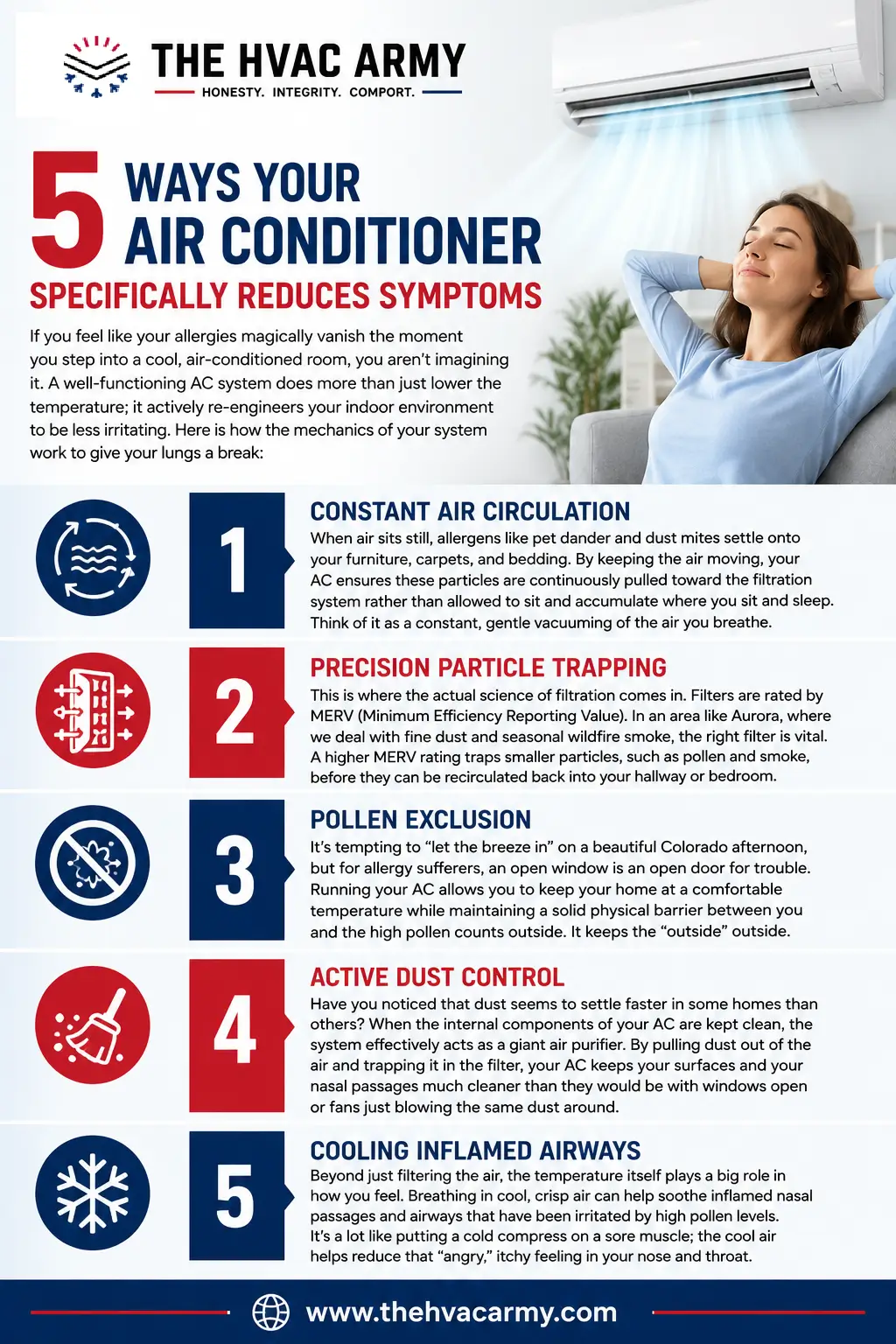
If you feel like your allergies magically vanish the moment you step into a cool, air-conditioned room, you aren’t imagining it. A well-functioning AC system does more than just lower the temperature; it actively re-engineers your indoor environment to be less irritating. Here is how the mechanics of your system work to give your lungs a break:
1. Constant Air Circulation
When air sits still, allergens like pet dander and dust mites settle onto your furniture, carpets, and bedding. By keeping the air moving, your AC ensures these particles are continuously pulled toward the filtration system rather than allowed to sit and accumulate where you sit and sleep. Think of it as a constant, gentle vacuuming of the air you breathe.
2. Precision Particle Trapping
This is where the actual science of filtration comes in. Filters are rated by MERV (Minimum Efficiency Reporting Value). In an area like Aurora, where we deal with fine dust and seasonal wildfire smoke, the right filter is vital. A higher MERV rating traps smaller particles, such as pollen and smoke, before they can be recirculated back into your hallway or bedroom.
3. Pollen Exclusion
It’s tempting to “let the breeze in” on a beautiful Colorado afternoon, but for allergy sufferers, an open window is an open door for trouble. Running your AC allows you to keep your home at a comfortable temperature while maintaining a solid physical barrier between you and the high pollen counts outside. It keeps the “outside” outside.
4. Active Dust Control
Have you noticed that dust seems to settle faster in some homes than others? When the internal components of your AC are kept clean, the system effectively acts as a giant air purifier. By pulling dust out of the air and trapping it in the filter, your AC keeps your surfaces and your nasal passages much cleaner than they would be with windows open or fans just blowing the same dust around.
5. Cooling Inflamed Airways
Beyond just filtering the air, the temperature itself plays a big role in how you feel. Breathing in cool, crisp air can help soothe inflamed nasal passages and airways that have been irritated by high pollen levels. It’s a lot like putting a cold compress on a sore muscle; the cool air helps reduce that “angry,” itchy feeling in your nose and throat.
When Your AC Becomes the Problem: Red Flags for Allergy Sufferers
While a clean system is your best defense, it can quickly turn into a source of irritation if it isn’t cared for. Because your AC is designed to pull moisture out of the air, it creates a damp environment inside the unit that requires regular attention. If you aren’t careful, the machine meant to protect you can start circulating the very triggers you’re trying to avoid.
Here are the primary red flags that your system is no longer helping your allergies:
- Musty Odors: If you notice a “stale” or “damp” smell when the fan kicks on, it’s usually a sign of biological growth on the evaporator coils. Research shows that roughly 60% of homes with moisture issues in their HVAC systems have elevated levels of airborne mold spores, which can lead to chronic respiratory irritation.
- Visible Dust Build-up: Take a look at your supply vents. If you see dark “fuzz” or thick dust clinging to the grates, your system is likely “bypassing” the filter. This happens when the filter is overloaded or doesn’t fit the rack perfectly, allowing unfiltered air to settle deep in your ductwork.
- Increased Sneezing Indoors: If your symptoms don’t improve after an hour of being home, your home’s air barrier is likely compromised. This is a clear indicator that you need a professional to check the integrity of your filtration system.
Advanced Solutions: Humidification and Filtration
Sometimes, even the best air conditioning maintenance isn’t enough to fully beat back Colorado’s unique environmental challenges. Our local air is notoriously thin and dry, which adds a painful layer to allergy season. When your nasal passages are dried out, they become cracked and sensitive, making it much easier for pollen and dust to cause an inflammatory reaction.
- Combatting Dry Colorado Air: Maintaining proper indoor humidity is a game-changer for respiratory health. A whole-house humidifier installation in Denver helps keep your home between 35% and 50% humidity. Research shows that maintaining these levels can reduce the survival of airborne viruses and significantly soothe the mucous membranes in your nose and throat—your body’s first line of defense against allergens.
- Total Home Health: We believe in looking at your home as a complete ecosystem. Just as clean air protects your lungs, clean water protects your skin and overall wellness. That is why we provide whole-home water filtration installation services in Denver and Aurora. Removing chlorine and hard minerals from your water can prevent the skin irritation and dryness that often go hand-in-hand with seasonal respiratory allergies.
Why Trust The HVAC Army
When you are looking for relief from seasonal allergies, you aren’t just looking for a technician; you are looking for someone you can trust inside your home. At The HVAC Army, we built our business on the idea that homeowners in Aurora and Metro Denver deserve better than the high-pressure sales tactics common in this industry.
- Family-Owned Integrity: We are a small, local team. When you call us, you aren’t getting a random subcontractor from a massive corporate fleet. You are working directly with Kam, Alex, or Ben. We treat every home like it’s our own because we live in this community, too.
- Proven Results: We take immense pride in our work, and it shows. We currently hold a perfect 5.0 Google rating with over 70 five-star reviews. Every single one of those reviews reflects our commitment to 100% customer satisfaction. We don’t consider the job done until you are breathing easier and feeling comfortable.
- Supporting Those Who Serve: Our name isn’t just for show; it represents the discipline and integrity with which we operate. We believe in honoring those who have protected our country, which is why we proudly offer a special military discount to all past and present U.S. service members from every branch. It’s our small way of saying thank you for your service.
By choosing The HVAC Army, you are choosing a team that is fully insured, master-licensed, and dedicated to honest, expert service. We show up on time, wear shoe covers to protect your floors, and provide the technical precision your home’s air quality deserves.
Conclusion: Does Air Conditioning Help with Allergies?
In summary, the answer to whether air conditioning helps with allergies is a clear yes, but with an important condition: the system must be clean and properly calibrated to serve as an effective barrier. While the mechanical process of cooling and dehumidifying naturally removes many environmental triggers, a neglected unit can quickly lose its filtration efficiency.
To ensure your home remains a sanctuary from seasonal irritants, it is essential to focus on regular maintenance and technical accuracy. A system that is balanced according to Colorado state mechanical codes and local building requirements ensures that your air is not just cold, but filtered correctly for the safety of everyone in the household. By staying proactive with filter changes and professional inspections, you can ensure your HVAC system remains a reliable tool for maintaining high indoor air quality year-round.
Frequently Asked Questions
Can dirty AC filters make allergies worse?
Yes. Dirty AC filters can circulate dust, pollen, pet dander, and other allergens throughout your home instead of trapping them. They can also lead to mold and poor indoor air quality.
What MERV filter is best for allergies?
MERV 11 to MERV 13 filters are typically best for allergy relief. They help capture pollen, dust, pet dander, mold spores, and smoke particles more effectively.
Does central AC remove pollen?
Yes. Central AC systems help reduce indoor pollen by filtering circulating air while keeping windows and doors closed during allergy season.
Should I run my AC during wildfire season?
Yes. Running your AC with a clean MERV 13 filter can help reduce smoke particles indoors and improve air quality during Colorado wildfire season.
How often should HVAC filters be changed in Denver?
Most Denver homeowners should change HVAC filters every 1 to 3 months. Homes with pets, allergies, or wildfire smoke exposure may need more frequent replacements.
